
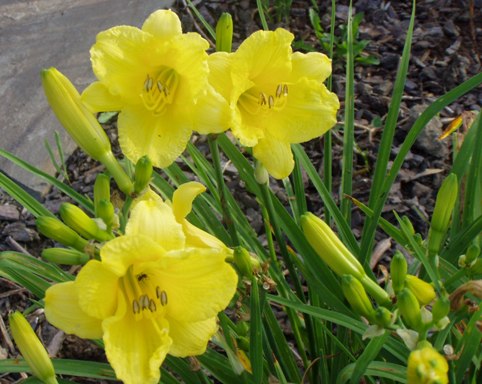
 There’s gardening and then there’s “gardening” (the competitive sport, English-style, all-in, heavy on the inputs sort of gardening).
Your dear Aunty does the first sort because frankly I’m cheap. I’m lazy. And I don’t like plants which require a lot of coddling. I’ll give anything a shot once but if it can’t survive my particular brand of neglect (which is almost total) or Chez Siberia’s specific microclimate ( on the USDA map, our area is Zone 4-5; at Chez Siberia, it’s Zone 2 in a lot of spots), I let the poor thing take its final trip to the compost heap without any grief, trust me.
Which means that if I’m in the mood for roses, I check out University of Minnesota or Canadian breeders — anything else basically will turn up its toes and die.
 On the other hand, I am also a huge fan of plants which have made the leap from local roadside, streambank and woodland and into the breeders hands. In general, things that are wild IN YOUR AREA, will, in the breeders hands, produce plants which you can put out in your garden with not a care in the world.
Exhibit A: Daylillies.
 Daylillies (hemerocallis) are NOT a member of the lily family – they have been placed into the family (I know you are just thrilled to bits to know this) Xanthorrhoeaceae. They are native to China, India and Japan and are such an uncomplaining perennial, and so easy to hybridize that there are now something like 60,000 registered cultivars. They were brought here by early settlers from England and they made the leap from cottage and farm garden to the roadside and across the country. In various parts of the country, they are referred to as ‘railroad lilies’, ‘road lilies’ and ‘outhouse lilies'(I kid you not). As a plant, it is unfussy about soil (mine grow in our grey clay with nary of whimper), water or lack thereof, sun or shade. There are some that are even repeat bloomers. The only downside is that you can’t find any in pure white or pure blue. Which I don’t see as a real disadvantage since we have so much else to choose from in terms of colors, singles and doubles and so on.
But notice what I didn’t say:
They are not invasive. They form their clump (which might get 18″ across) and then… stop.
They don’t require deadheading – every flower has its day in the sun (so to speak) and then it dies to be replaced by another one. If you want to neaten things up a bit, that is great, but you don’t have to.
They are almost impervious to insect pests – no spraying required.
They don’t require any fancy fertilizers or foliar feeding. Zippo.
The only thing you’ll need to do, at the end of the season in the fall, is remove the dead flower stems and cut back the dead foliage. No big deal at all. And after the clumps reach mature sizes (which takes about 3 years), you can split them up – you get babies for no cost at all. Another great feature is that they can be transplanted at any time during the growing season – as long as you can get them into the ground with a month left before the ground freezes, you are good to go.
And that, my friends, is what I call — sustainable.



Loved your post. I am a huge daylilly fan, too. But we aficianados here in Seattle are having a terrible time with daylilly gall midges. The moms come out of the soil in the spring and lay eggs in some (not all) of the very new daylilly buds, which completely deforms them. Then the affected buds drop into the garden soil where the eggs hatch, only to repeat the process the following spring. The do not affect the overall health of the plant and there is no control or cure other than to be viligant about removing the affected buds and destroying them. Some of my plants seem to suffer more than others but I have no idea why.
Daylily gall midges? Wow. Now, here in the Northeast, we have a gall midge that does it’s dirty work on goldenrod (no great loss there unless you are planting some of the new ‘decorative’ (hah) goldenrods), but daylily pests? Sacrilege.
The other great pest of daylillies are deer. Daylillies are chocolate cake to deer. The deer will not only eat the leaves and flowers (should it be given the opportunity to bloom before discovery) but will PAW UP THE BULB AND EAT IT TOO!!!. Further, the deer will come back and paw at the earth in following days to make sure it found all the bulbs.
Interesting – we have plenty of deer here but I’ve never had any damage from deer on my daylilies. Perhaps they prioritize the apple tree instead. 🙁