
 Good morning and Happy Mothers (and Grandmothers and Great-grandmas and people who care for kids everywhere – I think I covered it). Toughest and best job in the world. Do something really nice for yourself today.
My version of ‘doing something nice for myself’ involved working in the garden. And it occurred to me that someone else might find something useful in what I had to do this spring. Through shear negligence (laziness, running out of time in the fall, pick an excuse), I ended up leaving some of the onions in the garden. It’s not that hard to do, actually – the leaves die down and if I can’t see ’em, I don’t dig ’em up. So, this spring, when the snow finally left (and condolences to folks out in Michigan who got snow today), I found I had a whole bunch of onions that had survived the winter and had started to sprout. Now, when onions do that (and you see that in your bag under the sink, too), the outsides get soft and rather nasty. They can also split into smaller onions. It’s sort of like having your own little onion plant factory. So, I thought perhaps other gardeners, especially some of the newer ones, might find this technique as easy and useful as I do in terms of getting onions planted in the spring if you’ve left onions in the garden over the winter.
Very carefully, with a fork or spade, dig the clump of onions as early as you can – not right after it’s defrosted, but still early in the spring. The outside is going to be mushy – it’s ok. It’s not diseased or anything. It’s just that the mother bulb (my contribution to Mother’s Day) has moved on.
 When you dig it up, it will look something like this, with the sprouts and a whole lot of little white roots coming off the bottom. The roots are important. This is what will grow you whole new onions out of those sprouts.
Now, very carefully – and this all depends on how many sprouts are coming out of the bulb – put your thumb against the outside of the onion bulb and very carefully, push the end of your thumb into the mass and push away what’s left of the bulb. This will reveal the shoots and you can carefully split the sprouts apart into individual onion plants (the plot thickens, eh?). Work your way down from the green sprout end to the roots end, splitting as you go, making sure that when you split off the sprout, you have roots at the bottom end. If you break it and there are no roots, you’ve got a dandy green onion that you can use in cooking Chinese or in salads, but it won’t grow another onion. To plant the next onion plants, just dig holes as deep as the white part of the onion sprouts, put them in, cover them with dirt and firm it down. Easy.
 Now, just as a side-note, let’s look at that onion sprout again. Once you’ve split it up, it will look like this. Take a closer look at the roots end of things – see that area that is whiter? That’s called ‘the growth plate’ on onions. It’s also the part of the onion with the strongest flavor. So, when you are cooking – don’t just chop the onion. Take your knife and cut INTO the bottom of the onion a little way, as if you are coring an apple, and cut that out. Then chop the rest of the onion – you’ll find that there won’t be as much crying over the onions that way.
OK — NEXT: The Squirrel.
If a squirrel could be a combination of Stephen Hawking and an Olympic high jumper, we’ve got him here at Chez Siberia. We feed birds and use bird feeders with what are amusingly referred to as ‘squirrel baffles’ and we’ve always had a lot of success with them in terms of keeping the squirrels out of the feeders. No more. This guy figured out that if he did some training and could launch himself to the upper part of the feeder pole, he’d miss the baffle entirely, get at the seeds and peanuts and never have to share with anyone. At the moment, he’s looking positively porky out there.
We’re waiting for our citation from some animal health organization because he’s had a heart attack.
Other garden stuff:
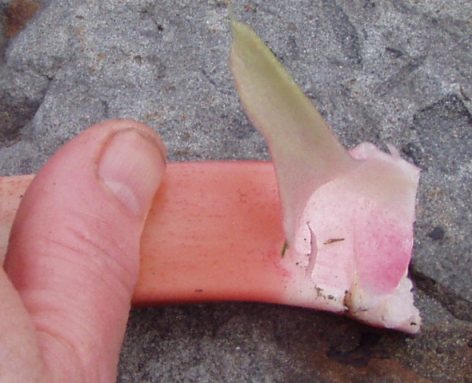 Here at Chez Siberia, now is prime rhubarb harvest time. As a matter of fact, we went from ‘just coming up’ to ‘OMG, I’ve got to get out there and cut the rhubarb’ in about a week. Crazy. And it occurred to your dear Aunty that a) a lot of people get their rhubarb earlier than we do here (no duh), and b) that a lot of people do not realize that rhubarb is like asparagus, best cut as early as you can and then don’t bother with it because the bigger it gets, the stringier and stronger it gets and is no longer worth eating unless you are looking for a whole lotta fiber in your diet. Hence the photo here of my rather stubby and grubby thumb showing you how thick this stalk of rhubarb is (which is, about an inch across). Cut your rhubarb early, when it is smaller across that 1″ (or the length of the first joint of your thumb – your choice). It’s much more tender and tasty that way.
Also, if I can offer a small piece of advice – and perhaps a cooking experiment. If you are going to be just cooking up a mess of rhubarb (spring tonic and all that), do your usual thing (wash, cut into chunks, throw into a pot with a bit of water, put on low and cook), but do not put in any sugar until you’ve cooked it.
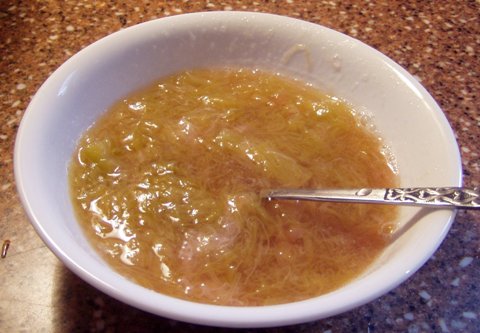 Then, taste it first. Get a feel in your mouth for just how sour it is (it might now be as sour as you think). Then add a small amount of sugar. In that bowl in the photo, there are four stalks of rhubarb cooked down. To make it just the least bit sweet, I put in two teaspoons of honey. That’s it. Just two. So, taste your rhubarb and add a little bit of sweetener and taste again. If you need more, then add more, but don’t just dump in the sugar because the tart-sweet flavor of rhubarb is a real spring treat and one not to be missed.
And, I’m patting myself on the back because I STILL have not planted the peppers and tomatoes. The weather folks say that we’re going to have temperatures as low as 26 over the next couple of nights, which means that at Chez Siberia, that will be 18-20 degrees F, something that would just kill off tender veggies. So, they stay in the greenhouse for now. Another couple of weeks until Memorial Day won’t hurt them.



Wonderful site. Plenty of helpful information here. I am sending
it to some pals ans also sharing in delicious.
And of course, thank you on your sweat!