OK, Peoples! In our last episode Honey, I broke the tomato we discussed how to use ‘rooting hormone’ (in this case, the powder form) to try to save the broken-off tops of two tomato plants. That was (ordinarily I don’t bother with dates, but in this case, I think it’s illustrative) June 6th. Today is June 16th and see the photo above. That little white thing coming out of the bottom of that plastic pot is… a root. So, there you have it – 10 days from “broke” to “ready to go into the garden.
I can’t illustrate it any more plainly than that.
Something else I’d like to discuss is fish emulsion. Now, I know there are a lot of people out there who use this all the time and I have to admit that in .. well, we won’t go into how long I’ve been gardening ..but in all my years of gardening, I’ve never used it. I used it this spring when we put all those tomato plants into the garden because we’d put them into some compost we’d gotten at the county landfill, which frankly was probably about 90% wood chips (yes, I know we discussed this last year and I should have learned my lesson, seriously), so they looked pretty weasely when we put them in. I thought they’d get off to a better start with some fish emulsion, which I mixed up according to directions and gave them a good douse at the roots when we put them into their holes. And I’m glad I did because they look 1000 % better now – the leaves are all green and the plants are filling out. One thing to remember about fish emulsion is that it has a really strong smell – use plastic gloves and devote a small measuring cup (just tie the thing to the bottle) to that use and that use only. It’s also thick and a bit gooey, so just put a little bit into the water jug you are using to mix it up in and swish it around, then add some more. You don’t want this to end up as a lump in the bottom of the jug. When you are done, wash your hands right away – it any of it sticks to your skin, it is very difficult to get the smell off (lemon juice works pretty well).
Fish emulsion is also used by many gardeners for what is called ‘foliar feeding.” If you’ve never done this, what foliar feeding does is take advantage of structures in the leaves called ‘stomata’. Now, the word “stomata’ sounds like ‘stomach’, right? But ‘stomata’ are actually more like mouths than they are like stomachs, because they open and close and you can actually get nourishment into them which can be used by the plant (yes, plants in the general scheme of things get most of their nourishment and water from what they are rooted in, through their roots). Plants can also absorb nutrients through the leaf surface itself, but more nourishment gets through the openings, the stomata.
Now, the way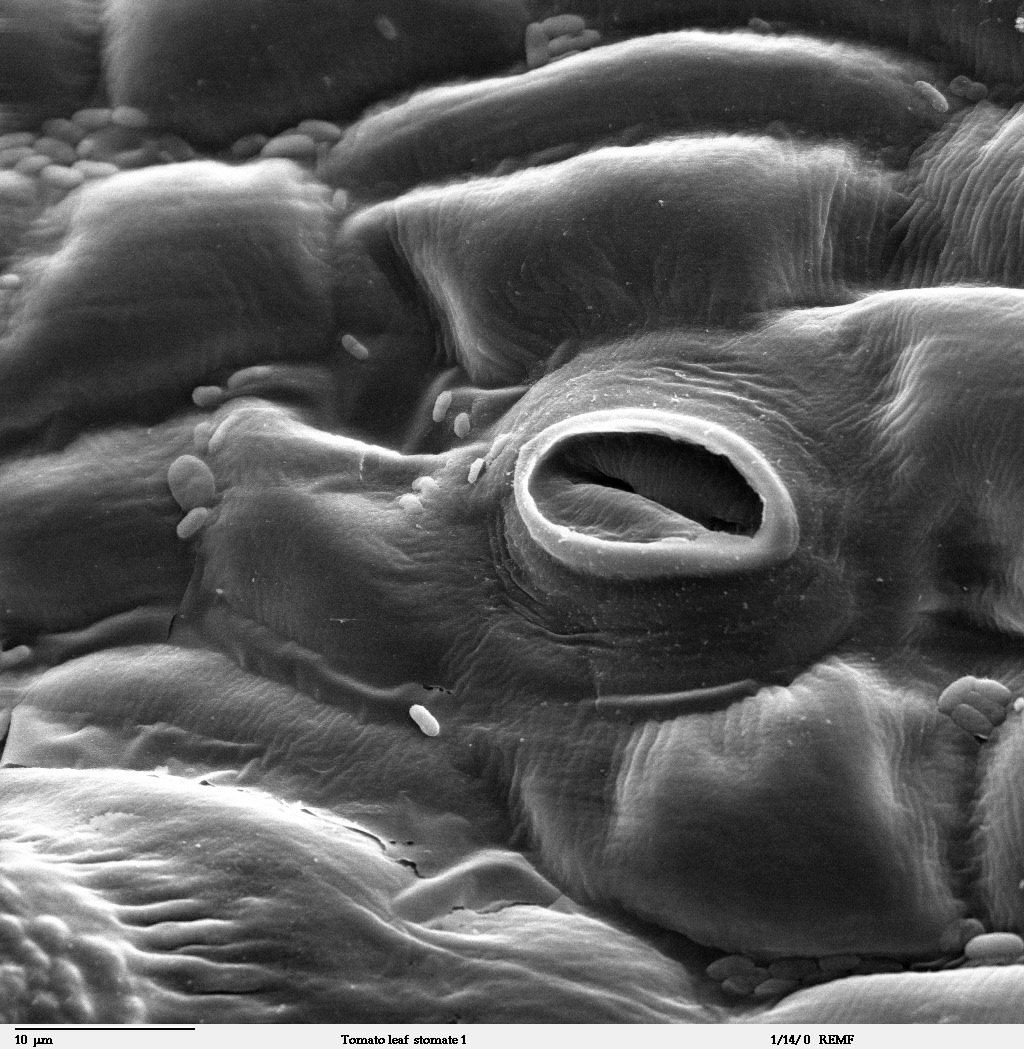 stomata work (see the photo), is that there are guard cells which open and close the opening. Stomata are also the structures through which plants ‘transpire’ (that is, lose water, go through the carbon dioxide cycle and so on) and actually, there are more of them on the undersides of the leaves than on the tops. During the hottest parts of the day, the guard cells close off the stomata – this is an important point to remember if you want to do foliar feeding because there is no reason to spray things like fish emulsion or kelp emulsion on plants between about 11 a.m. and 8 p.m. because the stomata are ‘closed for business’. So, for foliar feeding, early in the day or toward nightfall is the ticket there.
How to do foliar feeding? If whatever you are using to feed doesn’t come with instructions for foliar feeding, mix up a really weak solution – remember, you have to get this through the nozzle of a sprayer . And using a sprayer of any sort (a clean tank sprayer is probably best since you can get the nozzle UNDERNEATH the leaves and point it up to take advantage of the fact that there are more stomata there), give them a really good spray until the liquid starts to drip off the leaves. Then, spray the tops – yes, there are fewer stomata there but there are some and plants also absorb through the leaf surfaces as well, so you will get absorption there as well. Research has been done literally for the past 50 years which has shown that foliar feeding really works and even with plants such as tomatoes, which common wisdom tells us, should not have their leaves allowed to become wet because of diseases, benefit tremendously from foliar feeding.
(photo of tomato stomata in the public domain, courtesy of Photohound)